The quietest signal.
Token graphs feel like momentum, but they measure motion, not movement. The clearest sign an AI transformation is working is quieter — and almost impossible to screenshot.
There’s a moment in every AI rollout when the dashboards stop being interesting.
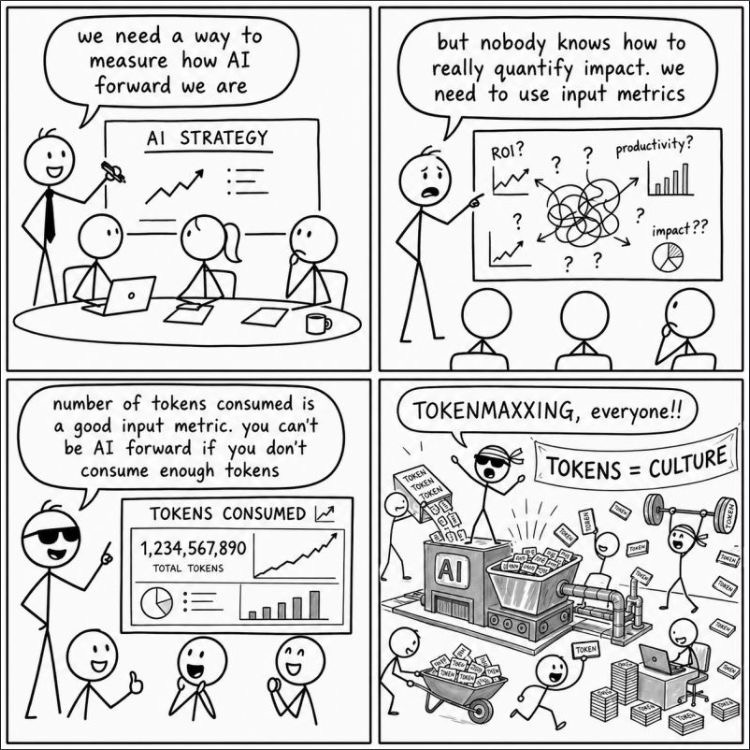
Early on, everyone watches the token graph. It climbs, and the climb feels like progress — proof that people are actually using the thing, that the money is paying off, that the future is arriving on time. Leadership screenshots it for the board. The number goes up and to the right, and up-and-to-the-right is the universal sign of momentum.
And then, if the transformation is really working, something odd happens. The number stops mattering. Not because usage drops, but because everyone quietly realises it was never measuring what they thought it was.
Activity is not adoption
Token use is the AI era’s version of lines of code, or hours logged, or meetings attended. It measures motion, not movement. A team can use a lot of tokens and change nothing about how the work actually flows — the same process as before, now with a chatbot bolted on the side, producing volume that looks like value on a chart.
The thing we were really trying to change was never the metric. It was the mindset. And a change in mindset is slow, human, and almost invisible to a usage dashboard.
AI isn’t a tool you bolt onto a process. It’s a process change that arrives looking like a tool.
So the real sign of progress isn’t how many tokens a team uses. It’s whether the work has reorganised itself around the new ability — whether people stopped asking “can I use AI for this?” and started assuming they would, the way you don’t ask permission to use a spreadsheet. When that shift happens, token counts become plumbing: important to keep running, boring to watch. The vanity metric retires itself.
The change in behaviour is the whole point
This is the part that change-management writing has been saying for decades, now in a new form. Every lasting transformation is, underneath, a shift in default behaviour. Not a new policy, not a new tool licence, not a training completion rate — a change in what people reach for without thinking.
The companies getting this right are running, knowingly or not, a textbook change programme. They re-educate first, so people understand what is actually changing instead of fearing it. They make room to experiment boldly, where failure is cheap and curiosity is rewarded. And only then do the genuinely ambitious use cases appear — because they come from people who have absorbed the ability, not from people who were handed a mandate.
The sign is that the barrier stops being technical and becomes psychological — and then that barrier falls too. “Tokens are expensive” becomes “tokens are cheap”. “AI can’t do this” becomes “let’s see how far AI gets”. That one sentence, said casually in a normal working conversation, is worth more than any dashboard. It means the assistant has become a colleague, and the process has quietly bent into a new shape.
A point worth being honest about
It’s tempting, watching this play out at the largest companies, to draw a straight line from AI adoption to smaller teams. Amazon does more with fewer people; Uber runs leaner; the headlines almost write themselves. AI made the org smaller, therefore AI works.
I’d be careful with that line. Much of the recent job-cutting at big tech comes from a mix of other reasons — a correction after over-hiring in the pandemic years, cost discipline driven by interest rates, ordinary reorganisation. AI is often just the story attached to cuts that were already happening, because “AI efficiency” is a much nicer thing to tell the markets than “we hired too many people”. The real productivity gains exist, but they are earlier and more unevenly spread than the headline numbers suggest.
The difference matters, and not only for accuracy. The companies that achieved a real change in behaviour mostly did not lead with headcount. They led with making AI genuinely useful in the daily flow of work, and whatever org changes followed came second — as an effect, not a goal. The moment a transformation is seen inside the company as a headcount exercise, the whole thing flips: people stop experimenting and start protecting their position. You cannot get bold experimentation out of a workforce that suspects the experiment is meant to replace it.
So the workforce numbers are a lagging, noisy, and sometimes misleading stand-in. In a way they are just another vanity metric — one that happens to point down instead of up, and carries a far higher human cost when it is misread.
What to actually watch
If tokens going up is a vanity metric, and headcount going down is a vanity metric, what is left to measure?
The honest answer is that the best signal is a soft one, almost impossible to screenshot: the casual sentence in the standup, the engineer who threw a whole messy problem at the AI and built the answer together with it rather than asking it to fill in a few lines of code, the business user who made something useful without waiting for engineering. None of these show up on a graph. They show up in the way people talk about their work.
We’re not buying AI tools. We’re rebuilding how we work. And the clearest sign that the rebuild is succeeding is that the metric everyone started by celebrating has become too boring to mention.